a-smoll-rev
Index
Main Idea for Get Flag : cmp Hooking
Stage 3: Completing the Input Format
Get Binary from Base64
The challenge provides the following file:
1
2
3
4
5
6
7
8
9
10
11
12
13
14
15
16
17
18
19
20
21
22
23
24
25
26
27
28
29
30
31
32
33
34
35
36
37
38
39
40
KLUv/WRQSs1DAJbpmjSw9hzCAKhV/tHuwhGqMVwB9yUQ9asvj+5/MvA45BffQuGBt+JU6O65Zq0J
X9bQNpeWbJlSiQCJAIgAfm+X+i/ef/Wh/jhuPNOoivSm3zPfm9kCsGjM6rWmLeEb6vnOUKry5/0u
MVdpzCx5P4uU92rSp6P+aplU82Ljl1n8K5BZ0gZ5P0v9uy/p5/fr9+cxQr/86pRZJJsdYtkvk+Xs
KvkIF/RHYkHT1zqqzBwZSZ75MlIjj9lpEn0+efbIbNaaJTmBGgVc92WjmocReO5rushL8Ngi9uAP
VBtTLtMD+AAhwZe/3k/9FW/cabNuWf7DcjWzhGuhXaQa9oJ355rBJ+OBNi7wUHEOayKVTFagkCra
EoPD4/j08OzNhHF5iUk2rSovX5EYi4p0Jfeq/glUzflMRpo/X4uSvtVE+TPcwJ/eO7Pbtm3rfe+c
Ozk5NBEVfWcUipjE5w2wcxPMsGGI/HbtukhH+jW+2QAHBAMCAcvkkc1cgfGtVYR74iLvW5513btn
k+u2Xguc+CWf52S2LYjv3r+0UT+M+N0svspFSGf2vQzHTE+mdzRL9bs3Erlk93GpzEnNVCKRyeXx
mESy7E4ud/LI4ZneO4cbO5eo8oyNbt6LWAHawCTjqJHR4x4IyEFBNhRZiAhHiCLb1AgBCQVNgyhy
26GMIVuZIYNYTldhSpaRFU5U4cQgILd+PVlBiALj/mclgh5Np3osnEYvoCWvq30Si+JVpH27KPRZ
N+3OOQdXTrdxYB7OrHW5mxYNdMhHtV38/3w6nWxULd/59GlLKxPryrKKemJSOlIi8pnStET/0+m2
vme5KlKDHqiCqy1JClKQSmviIoTBMJRlrZW8AfIQCqEYBsJJBGMIEJZCHLGIECJgRERkJCCZTZLW
woZg4ijiv8Vd6kXRj5U+8RLeUFr7edLySAzgxNz5nsl/qHb7/kxPUT6wTY3Qfwt583Wc9l77fPry
I5nTWq6ORxNbmIYQ9sMydZK+4ZR6l8uXZqb4dYtQfzpImREIFREpLIh3AzJYZEew4g72p3/Z07c2
O8iwAYQz3FdKh1brsANG/SuNex59I9d5w3sL/LSmn/YpGEQWGImZ68wfiP6V46Y3KiboYG1CSmHi
AO5xA7cIayReOSMAp6jW+64I4FkFlkyjyzgKAx4q9wzwmL3N3OSM+JNIU86hMWesAO88an7YnRME
/HqfdR/pP+nkU44Cnzwid0qdmla5W9VU7V5J3XevulwEC8gemtcMw3tIZrn8dWWiItDWuLdwsLs7
DmWaL1dQQsUt2evJi642M1MwKI/pVnLJmrxu1CNU0VmTGTPmUmKjpsjPYOng3BXQPAgN5OChkgqa
RfxBsN/kt03esrLkjtAuiJRozdAB8qSj3v8qQXUQp4owMM+gKa3VvZj+/PbzCw5JzUFcA9/Ht6Om
4s1zdpzKgyRcuR2cak71hbwaB3j3AMeBoFwzVntvGmXXdbKPmnJCqPDjJZwe2dSoq/mfqnQSpWkr
bvW4VNIVV56oUdTmP/oWPgU3nkjub65A4sPhEMM4WxEvHY9WRh6Vbfx+WR1+WDQJjb6wrdzRZymN
kAEe9MybJ25bMMZwQnczMaYUTd5d1USxvr6OWM21bZ/UhsUdWHTX0zBytxwg2ykeKLLlilEIeDrc
UXWA0i3rx82NiCVyaJXk1Gea8nECo806IDlYypUBrUbVjFUP9OdqvaXnaGnXOLD5y2FkOijzh+ij
ZAgZKgtmR5DyvN8IifXAtAJm4sol+PREaUKO9aEt4P0aGuJQWmrZJfxqVSeY37DskypXR/lCrNeM
kaFNa8tZ3xSWrxqKuUWuhM7y89MuVRPsSbOz2msmFQDVgxhIIdolpOfSVZsMKDbmGy9y9fe1iVM5
9CO0CLsTmJnAiQ8S9jQEfEaHzn5oxiPfYuizPPZqZMWJLefnTOW5+++sJZoRvHogdX9S0V+8P2VH
EH8SZj7LkNS+vW90fpljLEk4W4DMYAXcalAPDpoLjEnLAG0VvO/kChSii0WSNWMFt6h9SoZNv9V3
2+S5jZ18KdIJlQWalKoaSXGy+kHZeIkD91yuZ72KGfRp3MqPzJWJtO71pZprrdOXAB3mZoGn0h0U
bfvnq4ic++5hYItZ6IphwloGgLvSApExkVEt8Z4YA5WaV3ro1wn8aLFXhymm77Dbygo+OplGPu9j
S9ajAuMX/4IZVqlmTEaiA5jncZ/mCPkmLovUVIXPd7xNwi9DFmND5uvrBHlHN9cLJbzQ/5TZ3LVq
7kAStYgP4EHDYhuq/EHDEUNf9LnLi4eLJSdzbztSleVuE47xR4xw4Me9OLHxY+hIM3K2j6RoQEIA
iaOT9rhf0VsoQTmQzCrvJgeRTDliWJ4Sw5fRixJGYYpduNfqkbIaHYm65gz7Z0Km0VBiIeTfgcQM
VLl7tE6GgMwdSlRAsJoFeUyMOBxBXwUgvAKa/6UkyRycMDcKfQbbVUCsQkno4Gxr5C/OrFVNH0q8
PjfFDA1MwU+Wz+m7b7KPgtWdwRZEaTZFxoo/eGp8wnREWaiutSckpYkHqU3PrRNa11y4Ave4t57g
HWrmRmnSdCB4012umQdgWT+et8d6fd9kKSuELWth0o75oX+mW3PD4NiquSDiguuioR5e/RG3Q1vW
Zg4tKqzjAA63kCeKRtYh6R0brmh0Uzv0YB6OBrS6RfKZDneMC0SFgQjfRvYoQWVAWZMZbclI5Z45
DYV6OuLmsi5cWJgqyGWwtitBnaA6yipdKKmu94SmKKHSVvQXSsEIeYZxHMbM4gDx9J0j9+viMvCd
tJapg1Vv211ERmyctg1PVAo0H5ONicaBzXoSiWJb4xH2aMz5zJx1hhcbPCGzKr9RwUiz3PAqdn5C
jWx/pXZqh0ZLiCzuAsPenIE=
The data is clearly Base64-encoded. Decoding it produces a Zstandard-compressed file, and decompressing that file yields the ELF binary.
Main Idea for Get Flag : cmp Hooking
Opening the binary in IDA shows that it is heavily obfuscated.
The virtualization is particularly confusing, making it difficult to distinguish the virtual-machine routines from the program’s real logic.
After trying several approaches, the key idea was to hook instructions related to cmp. The virtual-machine routines did not contain cmp, whereas the real program logic necessarily used it to decide branches.
Hooking cmp therefore provided a starting point for tracing the branches that lead to a valid solution.
The following GDB script installs the hooks.
1
2
3
4
5
6
7
8
9
10
11
12
13
14
15
16
17
18
19
20
21
22
23
24
25
26
27
28
29
30
31
32
33
34
35
36
37
38
39
40
41
42
43
44
45
46
47
48
49
50
51
52
53
54
55
56
57
58
59
60
61
62
63
64
65
66
67
68
69
70
71
72
73
74
75
76
77
78
79
80
81
82
83
84
85
86
87
88
89
90
91
92
93
94
95
96
97
98
99
100
101
102
103
104
105
106
107
108
109
110
111
112
113
114
115
116
117
118
119
# gdb -q -x cmp-hook.py
import gdb

ge = gdb.execute
gp = gdb.parse_and_eval

ge("file ./dec_bin")

with open("cmp_log", "w") as f:
    f.write("")

class cmp_rdx_rsi(gdb.Breakpoint):
    def __init__(self, address):
        super(cmp_rdx_rsi, self).__init__(spec=f"*{address}")

    def stop(self):
        rip = int(gp("$rip"))
        rdx = int(gp("$rdx"))
        rsi = int(gp("$rsi"))
        val = int.from_bytes(bytes(gdb.selected_inferior().read_memory(rdx, 8)), "little")

        with open("cmp_log", "a") as f:
            f.write(f"{hex(rip)}: {hex(val)} == {hex(rsi)}\n")

        return False

class setl_rdx_rsi(gdb.Breakpoint):
    def __init__(self, address):
        super(setl_rdx_rsi, self).__init__(spec=f"*{address}")

    def stop(self):
        rip = int(gp("$rip"))
        rdx = int(gp("$rdx"))
        rsi = int(gp("$rsi"))
        val = int.from_bytes(bytes(gdb.selected_inferior().read_memory(rdx, 8)), "little")

        with open("cmp_log", "a") as f:
            f.write(f"{hex(rip)}: {hex(val)} < {hex(rsi)}\n")

        return False

class setnle_rdx_rsi(gdb.Breakpoint):
    def __init__(self, address):
        super(setnle_rdx_rsi, self).__init__(spec=f"*{address}")

    def stop(self):
        rip = int(gp("$rip"))
        rdx = int(gp("$rdx"))
        rsi = int(gp("$rsi"))
        val = int.from_bytes(bytes(gdb.selected_inferior().read_memory(rdx, 8)), "little")

        with open("cmp_log", "a") as f:
            f.write(f"{hex(rip)}: {hex(val)} > {hex(rsi)}\n")

        return False

class setnl_rdx_rsi(gdb.Breakpoint):
    def __init__(self, address):
        super(setnl_rdx_rsi, self).__init__(spec=f"*{address}")

    def stop(self):
        rip = int(gp("$rip"))
        rdx = int(gp("$rdx"))
        rsi = int(gp("$rsi"))
        val = int.from_bytes(bytes(gdb.selected_inferior().read_memory(rdx, 8)), "little")

        with open("cmp_log", "a") as f:
            f.write(f"{hex(rip)}: {hex(val)} >= {hex(rsi)}\n")

        return False

class setle_rdx_rsi(gdb.Breakpoint):
    def __init__(self, address):
        super(setle_rdx_rsi, self).__init__(spec=f"*{address}")

    def stop(self):
        rip = int(gp("$rip"))
        rdx = int(gp("$rdx"))
        rsi = int(gp("$rsi"))
        val = int.from_bytes(bytes(gdb.selected_inferior().read_memory(rdx, 8)), "little")

        with open("cmp_log", "a") as f:
            f.write(f"{hex(rip)}: {hex(val)} <= {hex(rsi)}\n")

        return False

cmp_rdx_rsi(0x0000000000401647)
cmp_rdx_rsi(0x0000000000401C38)
cmp_rdx_rsi(0x0000000000401CCC)
cmp_rdx_rsi(0x0000000000401CF6)
cmp_rdx_rsi(0x0000000000401E7D)
cmp_rdx_rsi(0x00000000004020B6)
cmp_rdx_rsi(0x0000000000402124)
cmp_rdx_rsi(0x00000000004023A3)
cmp_rdx_rsi(0x0000000000402FD9)
cmp_rdx_rsi(0x000000000040318D)
cmp_rdx_rsi(0x0000000000403426)
cmp_rdx_rsi(0x00000000004036CB)
cmp_rdx_rsi(0x0000000000403B72)

setl_rdx_rsi(0x0000000000401053)
setl_rdx_rsi(0x000000000040173D)
setl_rdx_rsi(0x0000000000401767)
setl_rdx_rsi(0x0000000000401870)
setl_rdx_rsi(0x0000000000401922)
setl_rdx_rsi(0x0000000000401DC9)
setl_rdx_rsi(0x0000000000403F12)

setnle_rdx_rsi(0x00000000004022AA)
setnle_rdx_rsi(0x0000000000403942)

setnl_rdx_rsi(0x0000000000401D3E)
setnl_rdx_rsi(0x0000000000403888)

setle_rdx_rsi(0x0000000000401D68)

ge("run < input", to_string=True)

exit()
Put an input in the input file and run the script to print the hook results.
Stage 1 : Input Format
After varying the input and observing the results,
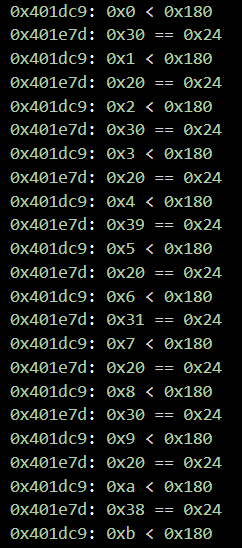
0x180 is the length of my input. The program reads it one byte at a time and compares each byte with 0x24 ($).
When it finds $, the comparison routine ends. In other words, $ is used as the input terminator.
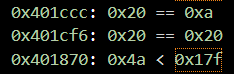
It then checks whether the next byte is \n or a null byte.
If the byte is neither of those characters,
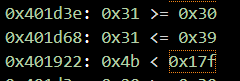
the program checks whether it is a digit from 0 to 9.
The process exits immediately if this validation fails.
After this validation, another check appears. Its purpose was difficult to determine precisely from the hook output alone.
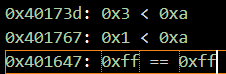
The program intermittently inserted 0xff == 0xff comparison routines. Some inputs passed them while others did not, which was initially confusing.
The later logic is needed to infer what these checks mean.
Stage 2 : Sudoku
After finding an input that passed and examining the subsequent logic,
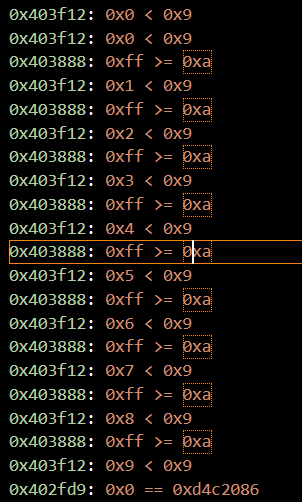
there is a routine that performs nine ?? >= 0xa checks and then compares a value with 0xd4c2086.
There are exactly 27 such routines.
There are exactly three program-counter locations at which the value is compared with 0xd4c2086,
with nine checks at each location, giving 27 in total.
0xd4c2086 is the product of the first nine primes, starting from 2.
This strongly suggests that the challenge is a Sudoku puzzle.
The three kinds of validation routines check rows, columns, and 3×3 blocks,
with nine checks for each kind.
There are also >= 0xa comparisons, some involving 0xff and others not.
This indicates that non-0xff values are pre-filled Sudoku cells, while 0xff represents an empty cell.
Stage 3: Completing the Input Format
We can now understand the meaning of 0xff == 0xff.
Because 0xff represents an empty cell, this check verifies that input is supplied for an empty cell rather than a pre-filled one.
Each Sudoku entry therefore requires three numbers:
<x coordinate> <y coordinate> <value>. CyKor’s D1N0 identified this format.
Solving the Sudoku
Submitting only $ reveals the Sudoku board with no values entered.
Extracting it gives the following board:
1
2
3
4
5
6
7
8
9
10
11
sudoku = [
    -1, -1, -1, -1, -1, -1, -1, -1, -1,
    -1, -1, -1, -1, -1,  3, -1,  8,  5,
    -1, -1,  1, -1,  2, -1, -1, -1, -1,
    -1, -1, -1,  5, -1,  7, -1, -1, -1,
    -1, -1,  4, -1, -1, -1,  1, -1, -1,
    -1,  9, -1, -1, -1, -1, -1, -1, -1,
     5, -1, -1, -1, -1, -1, -1,  7,  3,
    -1, -1,  2, -1,  1, -1, -1, -1, -1,
    -1, -1, -1, -1,  4, -1, -1, -1,  9
]
-1 denotes an empty cell.
The following Z3 solver solves the board and emits each value in the required input format for its corresponding cell.
1
2
3
4
5
6
7
8
9
10
11
12
13
14
15
16
17
18
19
20
21
22
23
24
25
26
27
28
29
30
31
32
33
34
35
36
37
38
39
40
41
42
43
44
45
46
47
48
49
50
51
52
53
54
55
from z3 import *

sudoku = [
    -1, -1, -1, -1, -1, -1, -1, -1, -1,
    -1, -1, -1, -1, -1,  3, -1,  8,  5,
    -1, -1,  1, -1,  2, -1, -1, -1, -1,
    -1, -1, -1,  5, -1,  7, -1, -1, -1,
    -1, -1,  4, -1, -1, -1,  1, -1, -1,
    -1,  9, -1, -1, -1, -1, -1, -1, -1,
     5, -1, -1, -1, -1, -1, -1,  7,  3,
    -1, -1,  2, -1,  1, -1, -1, -1, -1,
    -1, -1, -1, -1,  4, -1, -1, -1,  9
]

Ans = [
    [Int("Ans_{}{}".format(i, j)) for j in range(9)]
for i in range(9) ]

solver = Solver()

for i in range(9):
    for j in range(9):
        if sudoku[9 * i + j] != -1:
            print(sudoku[9*i + j])
            solver.add(Ans[i][j] == sudoku[9 * i + j])
        solver.add(And(1 <= Ans[i][j], Ans[i][j] <= 9))

for i in range(9):
    # Row
    solver.add( Distinct([Ans[i][j] for j in range(9)]) )
    # Column
    solver.add( Distinct([Ans[j][i] for j in range(9)]) )
    # Block
    solver.add( Distinct([Ans[3 * (i // 3) + j1][3 * (i % 3) + j2] for j1 in range(3) for j2 in range(3)]) )

while solver.check() == sat:
    model = solver.model()

    for i in range(9):
        s = ""
        for j in range(9):
            if sudoku[9 * i + j] == -1:
                s += f"{j} {i} "
                s += "{} ".format(model[Ans[i][j]].as_long())
        print(s)

    ex = True
    for i in range(9):
        for j in range(9):
            ex = And(ex, Ans[i][j] != model[Ans[i][j]].as_long())
    solver.add(ex)
    cnt += 1

else:
    print("NO")
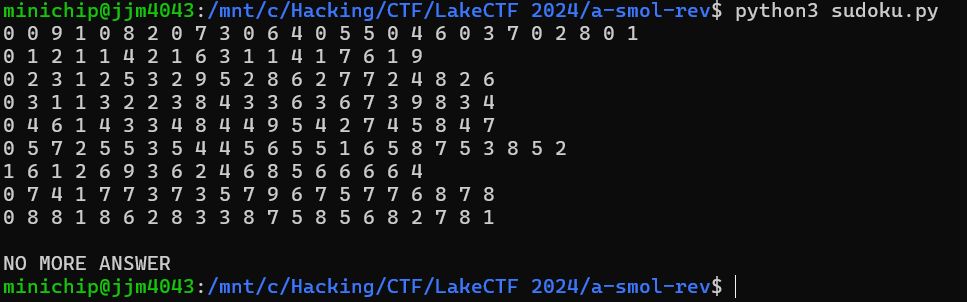
Sending the resulting input to the server
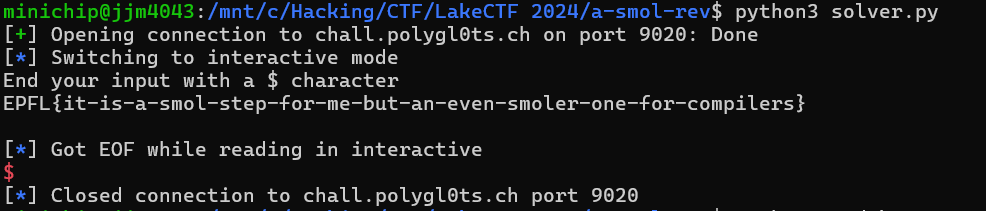
returns the flag.
Flag: EPFL{it-is-a-smol-step-for-me-but-an-even-smoler-one-for-compilers}