n1vm
Overview
This challenge required dealing with obfuscation techniques designed to hinder decompilation. In particular, the method used to conceal conditional branches by hiding the state of the EFLAGS register was quite fascinating. Even though many players manged to solve it, it’s still very interesting. Let’s get into the write-up.
Make the Function Decompilable
First, the decompiled result of the main() is shown below. It’s very simple, and it looks like we can easily recover the correct input by analyzing sub_1360().
1
2
3
4
5
6
7
8
9
10
11
12
13
14
15
16
17
18
19
20
21
22
23
24
25
26
27
28
29
30
31
32
33
34
35
36
37
38
39
40
int __fastcall main(int argc, const char **argv, const char **envp)
{
  __int64 v3; // rax
  __int64 v4; // rax
  __int64 v5; // rax
  __int64 v6; // rax
  std::ostream *v7; // rcx
  std::ostream *v8; // rax
  __int64 v9; // rax
  __int64 v10; // rax
  const char *v11; // rdx
  __int64 v13; // [rsp+20h] [rbp-38h] BYREF
  __int64 v14; // [rsp+28h] [rbp-30h] BYREF
  __int64 v15; // [rsp+30h] [rbp-28h] BYREF
  __int64 v16; // [rsp+38h] [rbp-20h] BYREF

  std::operator<<<std::char_traits<char>>(std::cout, "> ");
  v3 = std::istream::operator>>(std::cin, &v13);
  v4 = std::istream::operator>>(v3, &v15);
  v5 = std::istream::operator>>(v4, &v14);
  std::istream::operator>>(v5, &v16);
  v6 = sub_1360(v13, v15, v14, v16);
  v7 = std::cout;
  if ( v6 )
  {
    v13 ^= v15;
    v14 ^= v16;
    v8 = std::operator<<<std::char_traits<char>>(std::cout, "Congratulations, the flag is n1ctf{");
    v9 = std::ostream::operator<<(v8, sub_1000);
    v10 = std::ostream::operator<<(v9, v13);
    v7 = (std::ostream *)std::ostream::operator<<(v10, v14);
    v11 = (const char *)&unk_32A4;
  }
  else
  {
    v11 = "Wrong\n";
  }
  std::operator<<<std::char_traits<char>>(v7, v11);
  return 0;
}
However, once we decompile sub_1360(), things start to look quite suspicious.
1
2
3
4
5
6
7
8
// positive sp value has been detected, the output may be wrong!
void sub_140001360()
{
  __int64 v0; // [rsp-8h] [rbp-8h] BYREF

  qword_140006640 = (__int64)&v0;
  JUMPOUT(0x140001E8DLL);
}
Let’s take a look at the assembly.
1
2
3
4
5
6
7
8
9
10
11
12
13
14
15
16
17
18
19
20
21
22
23
24
.text:0000000140001360 sub_140001360   proc near               ; CODE XREF: main+76↑p
.text:0000000140001360                 mov     cs:qword_140006640, rsp
.text:0000000140001367                 lea     rsp, unk_1400066C0
.text:000000014000136E                 push    r15
.text:0000000140001370                 push    r14
.text:0000000140001372                 push    r13
.text:0000000140001374                 push    r12
.text:0000000140001376                 push    r11
.text:0000000140001378                 push    r10
.text:000000014000137A                 push    r9
.text:000000014000137C                 push    r8
.text:000000014000137E                 push    rbp
.text:000000014000137F                 push    rdi
.text:0000000140001380                 push    rsi
.text:0000000140001381                 push    rdx
.text:0000000140001382                 push    rcx
.text:0000000140001383                 push    rbx
.text:0000000140001384                 push    rax
.text:0000000140001385                 lea     rcx, unk_1400066D0
.text:000000014000138C                 lea     r8, qword_140006640
.text:0000000140001393                 mov     rsp, cs:qword_140006640
.text:000000014000139A                 lea     r14, loc_140001E8D
.text:00000001400013A1                 push    r14
.text:00000001400013A3                 retn
Look at the end of the assembly, we can see that it pushes the address of the next code region onto the stack and then executes a return. This doesn’t represent a real function return; it’s an obfuscation trick that replaces a direct jmp with a ret, effectively achieving an indirect jump-like obfuscation effect.
Other blocks were obfuscated the same way — lea <reg>, label; push <reg>; retn — and replacing that pattern with a jmp <imm> seems to strip away the obfuscation easily.
Below is a comparison showing the result of manually patching a single occurrence of this pattern.
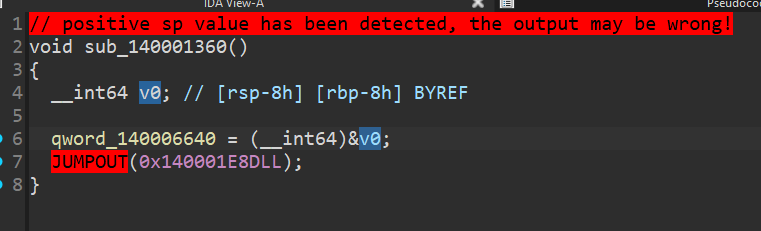
Before Patch
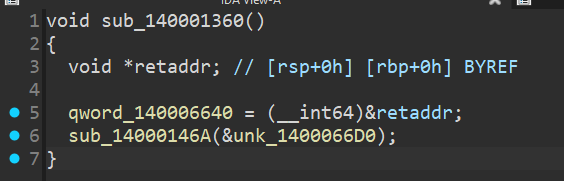
After Patch
If I patch all of those patterns the decompiler should produce much cleaner output — but there’s one more obfuscation left.
Take a look at the assembly below.
1
2
3
4
5
6
7
8
9
10
11
12
13
14
15
16
17
18
19
20
21
22
.text:0000000140001D32 sub_140001D32   proc near               ; DATA XREF: sub_140001D46+15↓o
.text:0000000140001D32                 push    qword ptr [r8+80h]
.text:0000000140001D39                 popfq
.text:0000000140001D3A                 ja      short loc_140001CDB
.text:0000000140001D3C                 lea     r15, loc_140001A46
.text:0000000140001D43                 push    r15
.text:0000000140001D45                 retn
.text:0000000140001D45 sub_140001D32   endp ; sp-analysis failed
.text:0000000140001D45
.text:0000000140001D46
.text:0000000140001D46 ; =============== S U B R O U T I N E =======================================
.text:0000000140001D46
.text:0000000140001D46
.text:0000000140001D46 sub_140001D46   proc near               ; DATA XREF: sub_1400015E2+42C↑o
.text:0000000140001D46                 mov     r12, [r8+8]
.text:0000000140001D4A                 cmp     r12, 1770h
.text:0000000140001D51                 pushfq
.text:0000000140001D52                 pop     r12
.text:0000000140001D54                 mov     [r8+80h], r12
.text:0000000140001D5B                 lea     r9, sub_140001D32
.text:0000000140001D62                 push    r9
.text:0000000140001D64                 retn
In addition to the jump-related obfuscation we saw, the code briefly saves the EFLAGS using pushfq, then — after the flags have been tampered with — restores them with popfq. IDA decompiler does not track pushfq / popfq , so if we leave those instructions unpatched the decompiler will generate a local variables corresponding to the ZF flag in the branch condition — but the variable appears uninitialized in the decompiler output.
From what I verified, there is always a ret-style obfuscation sequence between the pushfq and popfq — and there’s no meaningful code between them besides obfuscation.
So the plan is: patch the ret-based obfuscation as described earlier, and then, for the entire range between pushfq and popfq, replacing every instruction with nop except the jmp <imm> we inject to replace the ret pattern. By doing this the saved EFLAGS value (from pushfq) will be restored unchanged until popfq, which preserves the branch condition even in the decompiler output.
The full deobfuscation script is below.
1
2
3
4
5
6
7
8
9
10
11
12
13
14
15
16
17
18
19
20
21
22
23
24
25
26
27
28
29
30
31
32
33
34
35
36
37
38
39
40
41
42
43
44
45
46
47
48
49
50
51
52
53
54
55
56
57
58
59
60
61
62
63
64
65
66
67
68
69
70
71
72
73
74
75
76
77
78
79
80
81
82
83
84
85
86
87
88
89
90
91
92
93
94
95
96
97
98
99
100
101
102
103
104
105
106
107
108
109
110
111
112
113
114
115
116
117
118
119
120
from capstone import Cs, CsInsn, CS_ARCH_X86, CS_MODE_64
from capstone import CS_GRP_RET, CS_GRP_JUMP
from capstone.x86_const import *
from keystone import Ks, KS_ARCH_X86, KS_MODE_64
import lief

class Deobf:
    def __init__(self, bin_path: str):
        self.bin: lief.PE.Binary = lief.parse(bin_path)
        self.md = Cs(CS_ARCH_X86, CS_MODE_64)
        self.md.detail = True

        self.to_patch = []
        self.to_patch_nop = []

    def is_pattern(self, lea_insn: CsInsn, push_insn: CsInsn):
        if lea_insn.id == X86_INS_LEA and push_insn.id == X86_INS_PUSH:
            l_op = lea_insn.operands
            p_op = push_insn.operands[0]

            l_reg = l_op[0].reg
            p_reg = p_op.reg
            if l_reg != p_reg:
                return False

            label = push_insn.address + l_op[1].mem.disp
            return True, lea_insn.address, label
        elif lea_insn.id == X86_INS_MOV and push_insn.id == X86_INS_PUSH:
            m_op = lea_insn.operands
            p_op = push_insn.operands[0]

            m_reg = m_op[0].reg
            p_reg = p_op.reg
            if m_reg != p_reg:
                return False, None, None

            label = m_op[1].imm
            return True, lea_insn.address, label
        else:
            return False, None, None

    def scan(self, sa: int):

        text = None
        for sec in self.bin.sections:
            if sec.name == ".text":
                text = sec
                break

        code = self.bin.get_content_from_virtual_address(text.virtual_address, text.virtual_size)

        base = text.virtual_address
        basic_block_queue = [sa]
        end_block = []
        while True:
            insn_queue = []
            if len(basic_block_queue) > 0:
                ptr = basic_block_queue.pop(0)
                end_block.append(ptr)
                push_fq = 0
                for insn in self.md.disasm(code[ptr-base:], ptr):
                    insn_queue.append(insn)
                    if len(insn_queue) > 5:
                        insn_queue.pop(0)
                    if insn.id == X86_INS_PUSHFQ:
                        push_fq = insn.address
                    if insn.id == X86_INS_POPFQ:
                        self.to_patch_nop.append((insn.address-7, 8))
                    if insn.group(CS_GRP_JUMP):
                        if insn.id == X86_INS_JMP:
                            target = insn.operands[0].imm
                            if target not in basic_block_queue and target not in end_block:
                                basic_block_queue.append(target)
                            break
                        else:
                            target = insn.operands[0].imm
                            if target not in basic_block_queue and target not in end_block:
                                basic_block_queue.append(target)
                    if insn.group(CS_GRP_RET):
                        lea_insn = insn_queue[-3]
                        push_insn = insn_queue[-2]

                        res, addr, target = self.is_pattern(lea_insn, push_insn)

                        if res == True:
                            self.to_patch.append((addr, target))
                            if push_fq != 0:
                                self.to_patch_nop.append((push_fq, addr - push_fq))
                            if target not in basic_block_queue and target not in end_block:
                                basic_block_queue.append(target)
                            break
                        else:
                            break
            else:
                break
        return

    def patch(self):
        ks = Ks(KS_ARCH_X86, KS_MODE_64)

        for addr, label in self.to_patch:
            asm = f"jmp {hex(label)}"
            encoding, _ = ks.asm(asm, addr)

            self.bin.patch_address(addr, encoding)
        for addr, size in self.to_patch_nop:
            seq = [0x90 for _ in range(size)]
            self.bin.patch_address(addr, seq)

        builder = lief.PE.Builder(self.bin)
        builder.build()
        builder.write("patched.exe")
        return


if __name__ == "__main__":
    deobf = Deobf("problem.exe")
    deobf.scan(0x1360)
    deobf.patch()
After removing the obfuscation, the decompiled output looks like this. You can see that the obfuscation has been cleanly undone — the output is much clearer now.
1
2
3
4
5
6
7
8
9
10
11
12
13
14
15
16
17
18
19
20
21
22
23
24
25
26
27
28
29
30
31
32
33
34
35
36
37
38
39
40
41
42
43
44
45
46
47
48
49
50
51
52
53
54
55
56
57
58
59
60
61
62
63
64
65
66
67
68
69
70
71
72
73
74
75
76
77
78
79
80
81
82
83
84
85
86
87
88
89
90
91
92
93
94
95
96
97
98
99
100
101
102
103
104
105
106
107
108
109
110
111
112
113
114
115
116
117
118
119
120
121
122
123
124
125
126
127
128
129
130
131
132
133
// positive sp value has been detected, the output may be wrong!
void __fastcall sub_140001360()
{
  __int16 v0; // r10
  _QWORD *v1; // r13
  _QWORD *v2; // r11
  __int64 v3; // rsi
  __int64 v4; // r11
  __int64 v5; // r12
  __int64 v6; // rdx
  __int64 v7; // rdx
  __int64 v8; // r15
  __int64 v9; // r13
  _QWORD *v10; // r9
  char v11; // al
  unsigned __int64 v12; // r12
  __int64 v13; // r9
  __int64 v14; // rbx
  __int64 v15; // rbp
  __int64 v16; // [rsp-78h] [rbp-78h] BYREF
  _QWORD v17[14]; // [rsp-70h] [rbp-70h] BYREF

  REG[0] = (__int64)&v16;
  v15 = (__int64)v17;
  v17[0] = REG[2];
  v17[1] = REG[6];
  REG[10] = 0LL;
  REG[6] = (__int64)&unk_140005840 - 15040;
  v1 = (_QWORD *)REG[10];
  REG[1] = (__int64)v1;
  REG[2] = REG[10];
  REG[11] = REG[10];
  do
  {
    if ( (REG[3] & 1) != 0 )
    {
      REG[1] += *(_QWORD *)(REG[6] + REG[11] + 15040);
      v1 = (_QWORD *)(REG[6] + REG[11] + 12992);
      v15 = 653LL;
      REG[2] += *v1;
      if ( (unsigned __int64)REG[1] > 0x1770 )
        goto FAIL;
    }
    v15 += 292LL;
    REG[3] = (unsigned __int64)REG[3] >> 1;
    v7 = REG[11] + 8;
    v0 = v0 & 0x235 ^ 0x31D;
    REG[11] = v7;
    v12 = REG[11];
  }
  while ( v12 < 0x200 );
  REG[3] = REG[10];
  do
  {
    if ( (REG[4] & 1) != 0 )
    {
      v1 = (_QWORD *)REG[6];
      REG[1] += *(_QWORD *)((char *)v1 + REG[3] + 15552);
      v5 = REG[6];
      v6 = REG[2];
      v15 = *(_QWORD *)(v5 + REG[3] + 13504) + v6;
      v7 = v5 ^ v6;
      REG[2] = v15;
      v12 = REG[1];
      if ( v12 > 0x1770 )
        goto FAIL;
    }
    v12 *= 2LL;
    REG[4] = (unsigned __int64)REG[4] >> 1;
    v14 = REG[3] + 8;
    v15 -= v7;
    REG[3] = v14;
  }
  while ( (unsigned __int64)REG[3] < 0x200 );
  v4 = REG[10];
  REG[3] = v4;
  do
  {
    if ( (REG[8] & 1) != 0 )
    {
      REG[1] += *(_QWORD *)(REG[6] + REG[3] + 16064);
      v13 = REG[3] + 14016;
      v1 = (_QWORD *)(*(_QWORD *)(REG[6] + v13) + REG[2]);
      v14 = 2LL * (((unsigned __int16)v13 ^ (unsigned __int16)REG[6]) & 0x292);
      REG[2] = (__int64)v1;
      if ( (unsigned __int64)REG[1] > 0x1770 )
        goto FAIL;
    }
    REG[8] = (unsigned __int64)REG[8] >> 1;
    v11 = (_BYTE)v1 - 28;
    v1 = (_QWORD *)(REG[3] + 8);
    v4 -= 882LL;
    REG[3] = (__int64)v1;
  }
  while ( (unsigned __int64)REG[3] < 0x200 );
  do
  {
    if ( (REG[9] & 1) != 0 )
    {
      v8 = REG[1];
      v9 = REG[6];
      v10 = (_QWORD *)(v9 + REG[10] + 0x40C0);
      v11 = v9 | (v9 + LOBYTE(REG[10]) - 0x40) ^ ((((-79 - ((v8 | 0x88) - (LOBYTE(REG[10]) - 0x40))) ^ v8 & (v11 | 0xE2)) & 0x79)
                                                + 35
                                                - (LOBYTE(REG[10])
                                                 - 0x40));
      REG[1] = *v10 + v8;
      v2 = (_QWORD *)(REG[6] + REG[10] + 14528);
      v3 = *v2 + REG[2];
      v14 = (REG[2] - (_QWORD)v2) & 0x3A1 & (((((unsigned __int16)v10 & 0x29A) + 573LL) ^ (v14 - v9) ^ 0x1CB) - v3);
      REG[2] = v3;
      if ( (unsigned __int64)REG[1] > 0x1770 )
        goto FAIL;
    }
    REG[9] = (unsigned __int64)REG[9] >> 1;
    REG[10] += 8LL;
  }
  while ( (unsigned __int64)REG[10] < 0x200 );
  if ( (unsigned __int64)REG[2] >= 0x7B82 )
  {
    REG[2] = *(_QWORD *)(REG[0] + 8);
    REG[1] = 1LL;
    REG[6] = *(_QWORD *)(REG[0] + 16);
  }
  else
  {
FAIL:
    REG[1] = 0LL;
    REG[2] = *(_QWORD *)(REG[0] + 8);
    REG[6] = *(_QWORD *)(REG[0] + 16);
  }
  JUMPOUT(0x1400015BFLL);
}
Get the Flag
The input validation performs a simple running-sum check. To find an input that satisfies all the constraints, I had GPT implement a dynamic-programming–based solver for me.
1
2
3
4
5
6
7
8
9
10
11
12
13
14
15
16
17
18
19
20
21
22
23
24
25
26
27
28
29
30
31
32
33
34
35
36
37
38
39
40
41
42
43
44
45
46
47
48
49
50
51
52
53
54
55
56
57
58
59
60
61
62
63
64
65
66
67
68
69
70
71
72
73
74
75
76
77
78
79
80
81
82
83
84
85
86
87
88
89
90
91
92
93
94
95
96
97
98
99
100
101
102
103
104
105
106
107
108
109
110
# solver_global_strict.py
from table import table

LIMIT0 = 0x1770   # 6000
NEED1  = 0x7B82   # 31618

def parse_table():
    rcx_sum0 = table[256:256+64]
    rcx_sum1 = table[0:64]

    rdx_sum0 = table[256+64:256+128]
    rdx_sum1 = table[64:128]

    r8_sum0  = table[256+128:256+192]
    r8_sum1  = table[128:192]

    r9_sum0  = table[256+192:256+256]
    r9_sum1  = table[192:256]

    return [
        (list(map(int, rcx_sum0)), list(map(int, rcx_sum1))),
        (list(map(int, rdx_sum0)), list(map(int, rdx_sum1))),
        (list(map(int, r8_sum0)),  list(map(int, r8_sum1))),
        (list(map(int, r9_sum0)),  list(map(int, r9_sum1))),
    ]

def build_items():
    """items[j] = (pass_idx, bit_idx, w=sum0, v=sum1) 총 256개"""
    tabs = parse_table()
    items = []
    for p,(s0,s1) in enumerate(tabs):
        for b in range(64):
            items.append((p, b, s0[b], s1[b]))
    return items

def solve_global_strict():
    items = build_items()
    n = len(items)  # 256
    C = LIMIT0
    NEG = -10**18

    # dp[j][c]를 1차원 롤링으로 유지, 선택여부는 take[j][c]에 저장
    dp_prev = [0] + [NEG]*C
    # take는 (n+1) x (C+1) 비트메모리 (True면 j번째 아이템을 채택)
    take = [bytearray(C+1) for _ in range(n+1)]

    for j,(p,b,w,v) in enumerate(items, start=1):
        dp_cur = dp_prev[:]  # not-take 기본 반영
        if w <= C:
            # 0/1 knapsack 역순 갱신
            for c in range(C, w-1, -1):
                cand = dp_prev[c - w] + v
                if cand > dp_cur[c]:
                    dp_cur[c] = cand
                    take[j][c] = 1  # j번째 아이템을 선택해서 c에 도달
                # not-take의 경우엔 기본값(dp_prev에서 복사)이므로 0 유지
        # w > C면 아무 것도 못 넣음 → not-take만 유지
        dp_prev = dp_cur

    # 최적 용량 찾기
    best_c = max(range(C+1), key=lambda c: dp_prev[c])
    best_v = dp_prev[best_c]

    # 복원
    masks = [0,0,0,0]
    c = best_c
    for j in range(n, 0, -1):
        if take[j][c]:
            p,b, w,v = items[j-1]
            masks[p] |= (1<<b)
            c -= w  # 사용한 무게만큼 되돌림
    # c는 0이어야 정상
    # 재합산(교차검증)
    tabs = parse_table()
    used_sum0 = [0,0,0,0]
    used_sum1 = [0,0,0,0]
    for p,(s0,s1) in enumerate(tabs):
        m = masks[p]
        for b in range(64):
            if (m>>b) & 1:
                used_sum0[p] += s0[b]
                used_sum1[p] += s1[b]
    total0 = sum(used_sum0)
    total1 = sum(used_sum1)

    # 정확성 체크: DP값과 재합산값이 반드시 같아야 함
    assert best_v == total1, f"Recalc mismatch: dp={best_v} vs recalc={total1}"

    return {
        "rcx": masks[0] & ((1<<64)-1),
        "rdx": masks[1] & ((1<<64)-1),
        "r8":  masks[2] & ((1<<64)-1),
        "r9":  masks[3] & ((1<<64)-1),
        "pass_sum0_used": used_sum0,
        "pass_sum1_gain": used_sum1,
        "total_sum0": total0,
        "limit_sum0": LIMIT0,
        "total_sum1": total1,
        "threshold_sum1": NEED1,
        "ok": (total0 <= LIMIT0) and (total1 >= NEED1),
    }

if __name__ == "__main__":
    res = solve_global_strict()
    print("RCX=0x%016X  RDX=0x%016X  R8=0x%016X  R9=0x%016X" % (res["rcx"],res["rdx"],res["r8"],res["r9"]))
    print("sum0 per pass:", [hex(x) for x in res["pass_sum0_used"]], " total:", hex(res["total_sum0"]), "/", hex(res["limit_sum0"]))
    print("sum1 per pass:", [hex(x) for x in res["pass_sum1_gain"]])
    print("total sum1 = 0x%X (need ≥ 0x%X) -> %s" %
          (res["total_sum1"], res["threshold_sum1"], "OK" if res["ok"] else "FAIL"))
Flag: n1ctf{2c61982082d1af5052664054030285cd}